


2027 Rate Changes - Texas: +14.1% indy market; +16.9% sm. group market
Fri, 08/28/2026 - 12:37pm
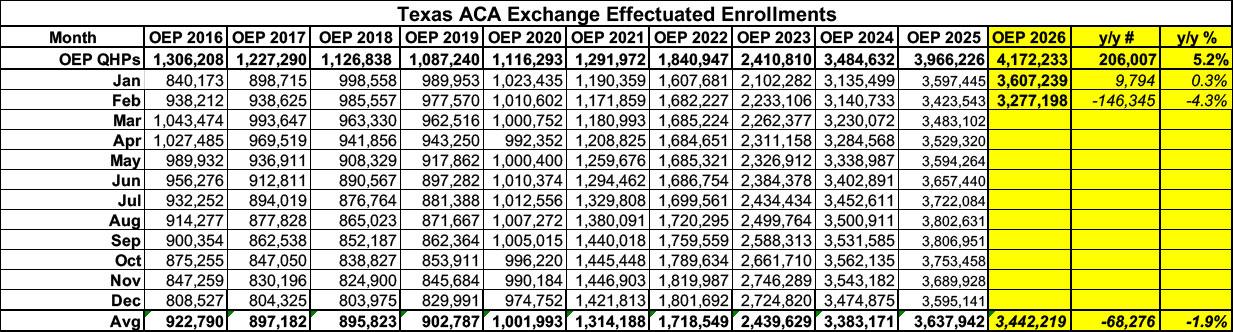
ACA exchange enrollment has only dropped by about 4% in Texas since Congressional Republicans allowed the enhanced federal subsidies to expire at the end of last year.
Initial signups during Open Enrollment were actually up about 5% vs. OEP 2025...but effectuated enrollment quickly dropped to practically even year over year in January and was down 4.3% as of February.
Still, thanks largely to Texas having a robust Premium Alignment policy in place (which they boosted a bit more this year, as I understand it), the drop-off in the Lone Star state has been far more modest than in most of the country. Even so, that's still over 146,000 Texans who lost healthcare coverage in just the first two months of the year.
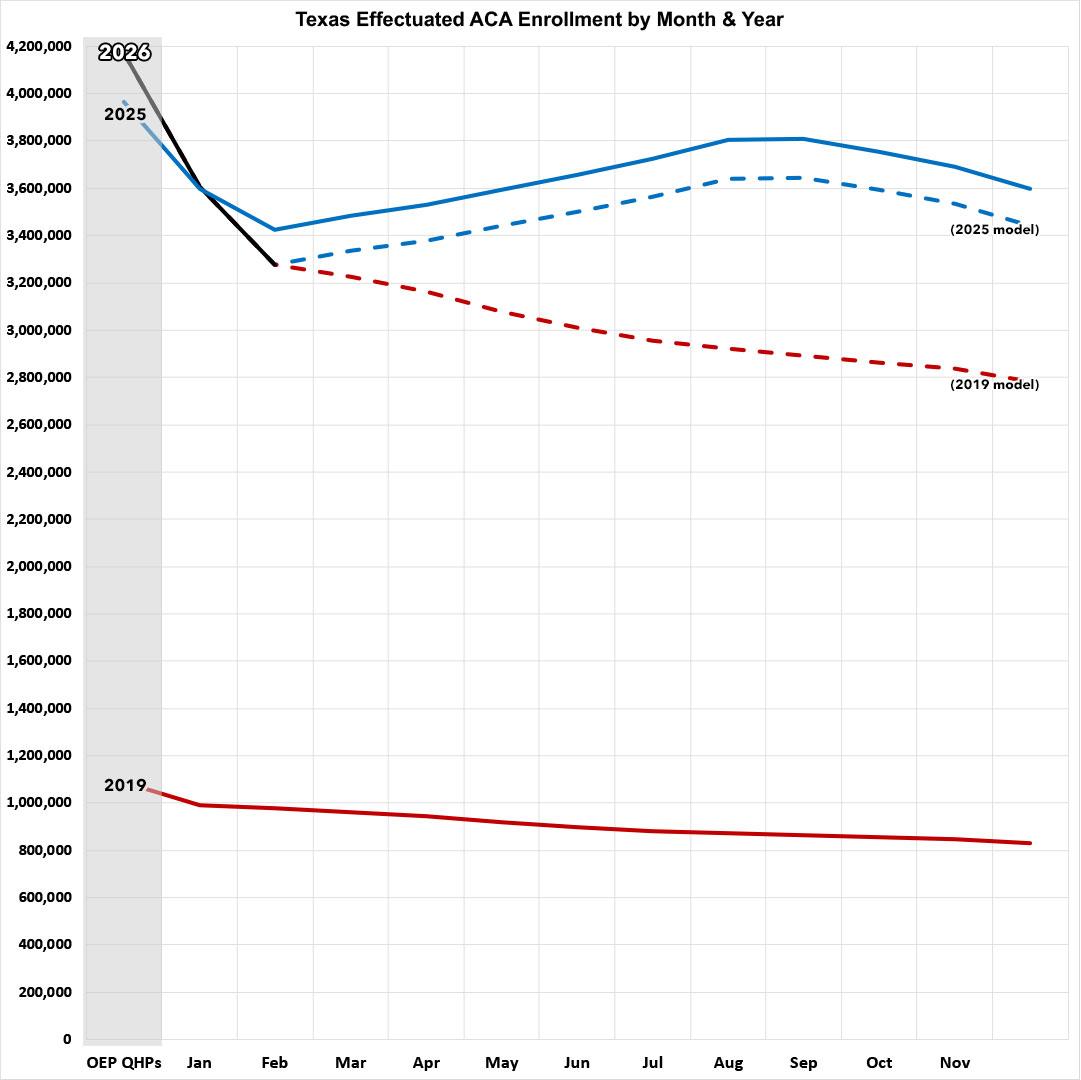
Here's what this looks like visually, with both 2025 and 2019 (the last pre-COVID year, which didn't include the enhanced subsidies) included for comparison:
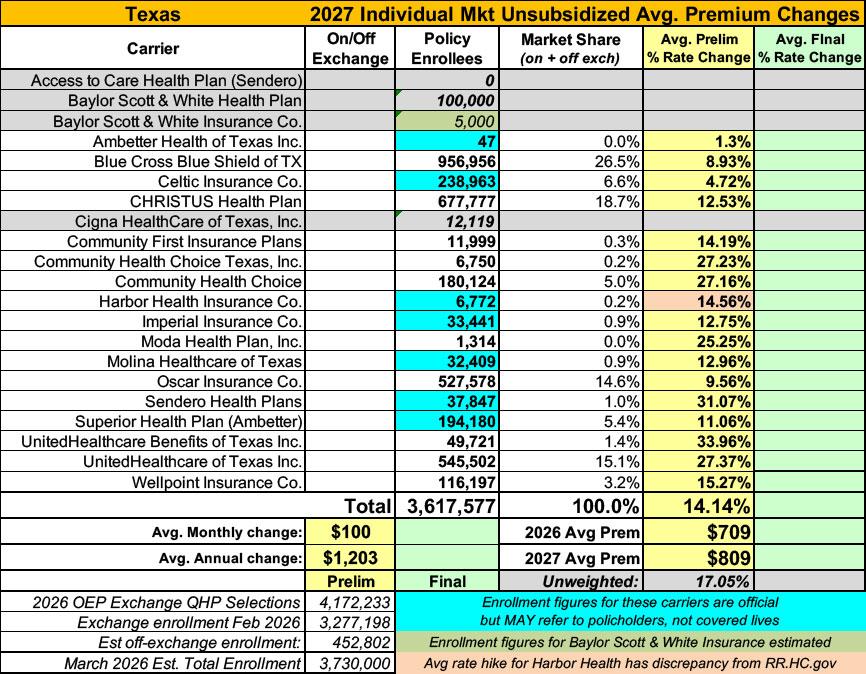
Looking ahead to 2027, the preliminary rate filings for both the individual and small group markets are now available via the federal Rate Review database:
ACCESS TO CARE (SENDERO):
- Company: Access to Care Health Plan
- Product Name: ACHP 2026
- State: Texas
- TOI: HOrg02I Individual Health Organizations - Health Maintenance (HMO)
- Sub-TOI: HOrg02I.005D Individual - HMO
- Filing Type: Withdrawal Notice
- Date Submitted: 06/08/2026
- SERFF Tr Num: ACHP-134978582
- SERFF Status: Closed-Informational
- State Tr Num: ACHP-134978582
- State Status: AC-ACCEPTED
Comments:
- a. No, ACHP was advised by Company licensing that no withdrawal plan was needed. See TIC 827.002(exemption from withdrawal plan requirements for transfer of business between affiliates).
- b. Bastrop, Burnet, Caldwell, Fayette, Hays, Lee, Travis, and Williamson Counties.
- c. There are no covered lives affected, as of January 1, 2026, ACHP has no members.
- d. As noted above, effective 1/1/2026, ACHP has no membership.
- e. There is no membership so no notices will be provided.
BAYLOR SCOTT & WHITE HP:
DALLAS — The Baylor Scott & White Health plan, which is the insurance arm of Baylor Scott & White Health, will no longer carry Texas Medicaid and individual marketplace plans starting this summer, according to a recent announcement from the company.
In an announcement on Tuesday, the health plan said it notified regulators of its plans to exit the Medicaid Managed Care Program on August 31, 2026, and discontinue Individual Marketplace Plans after December 31, 2026.
...The plan currently covers about 3.5% of the state's Medicaid enrollees, about 125,000 people, and 2.6% of its Marketplace customers, about 100,000 people, the announcement states. Plan members' current coverage will remain in place through the end of their enrollment period, according to the announcement.
As the changes take effect, some employees who support "the Medicaid and Marketplace lines of business will be impacted," officials said. The change will also have a limited impact on corporate services and other non-bedside roles, the announcement states.
"We are committed to supporting affected team members through this transition with new and unique resources that include dedicated career guidance, priority access to open roles in our system, funded reskilling for high-demand clinical positions, relocation reimbursements and extended medical benefits to help support continuity of coverage," the announcement states.
BAYLOR SCOTT & WHITE INSURANCE:
SERFF Filing -- Withdrawal from Individual Major Medical Market
This filing is provided in connection with Baylor Scott & White Insurance Company's withdrawal from the individual major medical market in the state of Texas (the “Withdrawal”).
A formal withdrawal plan (the “Plan”) was submitted to the Texas Department of Insurance pursuant to Tex. Ins. Code §827.003 and 28 Tex. Admin. Code § 7.1804 on April 10, 2026 and is pending review. The Company intends to begin the Withdrawal subsequent to the Department’s approval of this Plan and complete the Withdrawal by January 2, 2027.
A copy of the notice that will be provided to the policyholders is attached under the Supporting Documentation tab as “Policyholder Notice.”
A listing of the previously approved EPO and PPO benefit plans affected by the Withdrawal is attached under the Supporting Documentation tab as “Forms Affected by Withdrawal.”
AMBETTER HEALTH OF TX:
- Company Name: Ambetter Health of Texas, Inc.
- Company Rate Change: Increase
- Overall % Indicated Change: 1.300%
- Overall % Rate Impact: 1.300%
- Written Premium Change for this Program: $7,443
- Number of Policy Holders Affected for this Program: 47
- Written Premium for this Program: $577,729
- Maximum % Change (where req'd): 11.500%
- Minimum % Change (where req'd): -0.400%
BCBS OF TX:
Blue Cross and Blue Shield of Texas (BCBSTX) is filing new rates to be effective January 1, 2027, for its Individual ACA metallic coverage. As measured in the Unified Rate Review Template (URRT), the range of rate changes for these plans is -12.2% to 22.3%. The following are the average rate increases by product:
Product Rate Increase
- Blue Advantage HMO 8.8%
- Blue Advantage Plus POS 9.9%
Changes in allowable rating factors, such as age, geographical area, or tobacco use, may also impact the premium amount for the coverage.
There are currently 956,956 members on Individual Affordable Care Act (ACA) plans that may be affected by these proposed rates.
Financial Experience of the Product
Consistent with the filed URRT, earned premiums for all non-grandfathered Individual plans during calendar year 2025 were $7,417,034,265 and total claims incurred were $7,872,034,708. The proposed rates effective January 1, 2027 are expected to achieve the loss ratio assumed in the rate development.
Changes in Medical Service Costs
The proposed rates reflect expected change in year over year medical service and prescription drug costs, which includes changes in reimbursement rates to providers, changes in expected utilization of services, the mix and intensity of services, and the introduction of new procedures and technologies.
Changes in Benefits
There are no legally required changes to covered benefits and no significant changes to the benefit structure. Cost-sharing changes were made within these products allowing plans to maintain their metal status, which can contribute to the change in rates.
Administrative Costs and Anticipated Margins
The Affordable Care Act expects health plans in the individual market to spend at least 80% of each premium dollar they collect to pay for medical care and activities that improve health care quality for members. If health plans fail to spend at least 80% on medical claims and health care quality initiatives, they are required to give back money to consumers through a premium rebate. These rates assume BCBSTX will once again exceed the 80% threshold.
CELTIC INSURANCE:
- Company Name: Celtic Insurance Company
- Company Rate Change: Increase
- Overall % Indicated Change: 4.600%
- Overall % Rate Impact: 4.600%
- Written Premium Change for this Program: $157,563,927
- Number of Policy Holders Affected for this Program: 238,963
- Written Premium for this Program: $3,450,665,861
- Maximum % Change (where req'd): 6.100%
- Minimum % Change (where req'd): 2.000%
CHRISTUS HEALTH:
1. Scope and range of the rate increase — Provide the number of individuals impacted by the rate increase. Explain any variation in the increase among affected individuals (e.g., describe how any changes to the rating structure impact premium).
The purpose of this memorandum is to request a rate increase effective January 1, 2027, for CHRISTUS Health Plan’s (CHP) individual market plans. This justification is intended to comply with the requirements of CMS and, the State of Texas Department of Insurance (TDI). This justification may not be appropriate for purposes or scopes beyond those described above and, therefore, should not be used for other purposes.
The rate increase requested for CHP’s individual market plans impacts 677,777 members. The composite requested rate increase from 2025 to 2026 is 12.53% across all members.
Four plans will have a rate increase of over 15%. One plan, a Catastrophic plan (66252TX0380100), has a proposed 28.9% rate increase which is mostly due to updated eligibility requirement based on the change of enrollment from 2025 to April 2026. The Catastrophic eligibility factor increased from 0.8824 in 2026 filing to 1.0304 in 2027 filing, a 17% increase in premium rates. The remaining 12% increase is explained below. The other three Value Silver plans have rate increases of 15%-16% (66252TX0380010, 66252TX0380012, and 66252TX0410010) and they are all variations of the same plan design offered on the exchange, off the exchange, or with adult dental/vision benefits. All plans saw increases due to the higher projected risk adjustment payment than the initial filing due to the final 2025 risk adjustment report.
2. Financial experience of the product — Describe the overall financial experience of the product, including historical summary-level information on historical premium revenue, claims expenses, and profit. Discuss how the rate increase will affect the projected financial experience of the product.
In 2025, CHP collected $408 million in premium, incurred $373 million in net claim expenses, and $32.0 million in federal risk adjustment payments, resulting in a 92.51% loss ratio for its individual market plans as seen in URRT Part I.
3. Changes in Medical Service Costs — Describe how changes in medical service costs are contributing to the overall rate increase. Discuss cost and utilization changes as well as any other relevant factors that are impacting overall service costs.
The Catastrophic plan and the Value Silver plans will have a medical cost increase due to claim trends, morbidity adjustment, medical management savings, and PBM contract change as discussed in Part III Actuarial Memorandum.
4. Changes in benefits — Describe any changes in benefits and explain how benefit changes affect the rate increase. Issuers should explain whether the applicable benefit changes are required by law.
Catastrophic plan and Value Silver plans increased deductible and MOOP in 2027 to comply with the AVC requirements.
5. Administrative costs and anticipated margins — Identify the main drivers of changes in administrative costs. Discuss how changes in anticipated administrative costs and underwriting gain/loss are impacting the rate increase.
CHP’s anticipated admin cost and margin in total as a percentage of premium slightly increased from 12.7% to 13.7% in 2027.
CIGNA HEALTHCARE OF TX:
I am writing to notify the Texas Department of Insurance (the “Department”) that Cigna Healthcare intends to exit the individual medical market effective December 31st, 2026. This notification and associated Withdrawal Plan are sent pursuant to; Texas Insurance Code Chapter 827, TAC §§7.1801-7-7.1808 and Texas Department of Insurance, Withdrawal Guidelines, FIN365 (072025).
The details of our individual medical market exit include the following:
- Number of Lives Impacted: 12,119 (including both on and off exchange).
- Affected Texas Counties: Collin, Crosby, Dallas, El Paso, Ellis, Hunt, Johnson, Kaufman, Lubbock, Rockwall, and Tarrant.
- Product Forms Impacted: CCGH-134521148, CCGH-134521175, CCGH-134518012, CCGH-134521173, CCGH-134518053.
- Effective Date of Non-renewal: January 1, 2027
- Line of Business Impacted: Individual HMO
While we are withdrawing our individual medical market products, Cigna Healthcare intends to file for and provide an ACA (on-exchange) individual dental market offering for the 2027 plan year. We look forward to continuing to work collaboratively with the Department to support an orderly transition and are committed to meeting all regulatory and consumer-protection obligations associated with this process.
COMMUNITY FIRST:
This submission is for individual health insurance products offered by Community First Insurance Plans (CFIP) in the Texas individual market, available for sale January 1, 2027. CFIP is increasing premium rates for individual plans by 14.19% in aggregate, with a minimum of 12.99% and a maximum of 15.23%. As of March 2026, there are 11,999 members who are affected by this rate filing if they were to purchase the same plan in 2027.
Financial Experience of the Product
The individual market financial experience for calendar year 2025 was as follows:
- Premiums Earned before Risk Adjustment: $30,114,085
- Risk Adjustment Transfer Amount $7,900,000
- Incurred Claims before Risk Adjustment or Reinsurance: $30,679,323
- Member Months: 41,840
The proposed rates are projected to produce a 2027 medical loss ratio (as reflected in the URRT Part III) of 80.97%.
Changes in Medical Service Costs
Components of the rate increase include normal secular medical and prescription drug inflation, expected changes in the quantity and type of services used, changes to the morbidity levels of 2027 enrollees, and estimated risk adjustment transfer amount for 2027.
4. Changes in Benefits
Benefit design changes were made to a number of cost-sharing parameters, including updating maximum out-of-pockets and other copay levels to meet the de minimis criteria in the HHS AV Calculator.
5. Administrative Costs and Anticipated Margins
Administrative costs are based on the 2027 business plan and were not a primary driver of the rate increase, as they are largely consistent with 2026 pricing.
COMMUNITY HEALTH CHOICE TX:
This submission is for individual health insurance products offered by Community Health Choice Texas’ (CHC) on and off Exchange, available for sale January 1, 2027. CHC is increasing premium rates for individual plans by 27.23% in aggregate, with a minimum of 17.98% and a maximum of 29.32%. The rate increase is an average across all geographic areas; a specific member’s increase can differ from this average. As of April 2026, there are currently 6,750 members who are affected by this rate filing if they were to purchase the same plan in 2027.
2. Financial Experience of the Product
The individual market financial experience for calendar year 2025 was as follows:
- Premiums Earned before Risk Adjustment: $8.20 Million
- Risk Adjustment: -$2.40 Million
- Incurred Claims: $4.80 Million
- Member Months: 19,617
The proposed rates are projected to produce a 2027 medical loss ratio (as defined by the Affordable Care Act) of 81.29%.
3. Changes in Medical Service Costs
Components of the rate increase include updates to medical trend, changes in anticipated demographics of the enrolled population, network changes, and projected risk adjustment transfer. We have assumed the morbidity of enrollees and CHC and the market will increase as a result of the expiration of enhanced advanced premium tax credits, and this will drive an additional increase in plan costs for 2027 relative to prior years. Specifically, the market risk factor has gone up in 2025 much more than anticipated and CHC has not seen a corresponding increase in its own risk factor, leading to a reduction in the projected risk adjustment receivable, which historically has represented a significant receivable. Projected 2026 experience drives a higher baseline relative to experience, to which these changes are applied and constitutes a significant portion of the rate increase (i.e., we are adjusting rates to be commensurate with prior claim / risk adjustment experience for this business).
4. Changes in Benefits
Benefit design changes were made to a number of cost-sharing parameters, including updating maximum out-of-pockets and deductibles according to federal limits which mitigates the rate increase in many cases. We updated the load on on-exchange silver plans to be consistent with new requirements from TDI.
5. Administrative Costs and Anticipated Margins
The 2027 business plan projections for administrative expenses have been used, which are moderately higher than the assumptions used in 2026 rate development.
COMMUNITY HEALTH CHOICE:
This submission is for individual health insurance products offered by Community Health Choice’s (CHC) on and off Exchange, available for sale January 1, 2027. CHC is increasing premium rates for individual plans by 27.18% in aggregate, with a minimum of 23.97% and a maximum of 31.51%. The rate increase is an average across all geographic areas; a specific member’s increase can differ from this average. As of April 2026, there are currently 180,124 members who are affected by this rate filing if they were to purchase the same plan in 2027.
2. Financial Experience of the Product
The individual market financial experience for calendar year 2025 was as follows:
- Premiums Earned before Risk Adjustment: $918.30 Million
- Risk Adjustment: $197.30 Million
- Incurred Claims: $1062.00 Million
- Member Months: 1,519,147
The proposed rates are projected to produce a 2027 medical loss ratio (as defined by the Affordable Care Act) of 84.61%.
3. Changes in Medical Service Costs
Components of the rate increase include updates to medical trend, changes in anticipated demographics of the enrolled population, network changes, and projected risk adjustment transfer. We have assumed the morbidity of enrollees and CHC and the market will increase as a result of the expiration of enhanced advanced premium tax credits, and this will drive an additional increase in plan costs for 2027 relative to prior years. Specifically, the market risk factor has gone up in 2025 much more than anticipated and CHC has not seen a corresponding increase in its own risk factor, leading to a reduction in the projected risk adjustment receivable, which historically has represented a significant receivable. Projected 2026 experience drives a higher baseline relative to experience, to which these changes are applied and constitutes a significant portion of the rate increase (i.e., we are adjusting rates to be commensurate with prior claim / risk adjustment experience for this business).
4. Changes in Benefits
Benefit design changes were made to a number of cost-sharing parameters, including updating maximum out-of-pockets and deductibles according to federal limits which mitigates the rate increase in many cases. We updated the load on on-exchange silver plans to be consistent with new requirements from TDI.
5. Administrative Costs and Anticipated Margins
The 2027 business plan projections for administrative expenses have been used, which are slightly higher than the assumptions used in 2026 rate development.
HARBOR HEALTH:
Harbor Health entered the Texas individual market in 2026. For the 2027 plan year, the average proposed rate increase across all benefit plans is 14.56%. Plan-specific rate adjustments range from a minimum increase of 13.7% to a maximum increase of 18.8%.
Financial Experience
Because 2026 represents Harbor Health's initial year of operation in the Texas individual market, historical claim experience was insufficient to serve as the sole baseline for 2027 rate development. Consequently, a comprehensive rate manual was developed utilizing credible, publicly available market data from Texas individual health insurance carriers, supplemented by actuarial adjustments.
Reason for the Rate Increase(s)
The proposed rate adjustments are driven primarily by the following factors:
Changes in Medical and Pharmacy Costs: Rates reflect anticipated growth in medical service and prescription drug expenses. Primary cost drivers include price inflation, increased service utilization, shifts in service mix and intensity, updated provider reimbursement structures, and the emergence of novel therapeutics and clinical technologies.
Market Morbidity: Adjustments account for expected shifts in overall market morbidity across the Texas individual pool, increasing the baseline premium required to cover health expenses.
Risk Adjustment Transfer Projections: Harbor Health projects a net payable risk adjustment transfer for the 2027 plan year. This expected transfer is driven by two key factors typical of initial market entry: attracting a healthier-than-average member population and experiencing initial diagnostic coding lag relative to established market competitors.
Benefit Design and Metal Tier Compliance: Minor plan design modifications were made to ensure continued alignment with the CMS Actuarial Value (AV) Calculator and maintain statutory metal tier requirements, which contributed marginally to the overall rate change.
- Company Name: Harbor Health Insurance Co.
- Company Rate Change: Increase
- Overall % Indicated Change: 14.560%
- Overall % Rate Impact: 14.560%
- Written Premium Change for this Program: $7,400,133
- Number of Policy Holders Affected for this Program: 6,772
- Written Premium for this Program: $50,846,715
- Maximum % Change (where req'd): 18.8100%
- Minimum % Change (where req'd): 13.700%
IMPERIAL INSURANCE:
- Company Name: Imperial Insurance Companies, Inc
- Company Rate Change: Increase
- Overall % Indicated Change:12.750%
- Overall % Rate Impact: 12.750%
- Written Premium Change for this Program: $29,074,809
- Number of Policy Holders Affected for this Program: 33,441
- Written Premium for this Program: $228,037,716
- Maximum % Change (where req'd): 18.7600%
- Minimum % Change (where req'd): 6.580%
MODA HEALTH PLAN:
- Company Name: Moda Health Plan, Inc.
- Company Rate Change: Increase
- Overall % Indicated Change: 22.510%
- Overall % Rate Impact: 22.510%
- Written Premium Change for this Program: $2,657,019
- Number of Policy Holders Affected for this Program: 1,314
- Written Premium for this Program: $11,803,726
- Maximum % Change (where req'd): 22.670%
- Minimum % Change (where req'd): 17.570%
IMPORTANT: This specifies policyholders, not covered lives. There's typically an average of between 1.2 - 1.5 covered lives per policy for ACA individual market coverage, although there are outliers, which suggests that Moda may actually have had closer to ~1,700 actual enrollees last spring.
However, I've seen numerous cases where insurance carriers inexplicably list the exact same number for both policyholders and covered lives (which is statistically virtually impossible, since that would mean that every single enrollee was the only one on their policy), so I'm using the 1,314 figure as "covered lives" on the spreadsheet below, with a caveat/footnote included.
I'm doing the same for about half of the other carriers which also list the number of policyholders but not the number of covered lives in their rate filing forms.
MOLINA HEALTHCARE:
- Company Name: Molina Healthcare of Texas, Inc.
- Company Rate Change: Increase
- Overall % Indicated Change: 12.730%
- Overall % Rate Impact: 12.730%
- Written Premium Change for this Program: $64,705,250
- Number of Policy Holders Affected for this Program: 32,409
- Written Premium for this Program: $508,289,474
- Maximum % Change (where req'd): 13.140%
- Minimum % Change (where req'd): 0.000%
OSCAR INSURANCE:
The purpose of this document is to present rate change justification for Oscar Health Plan of Pennsylvania, Inc (Oscar’s) Individual Affordable Care Act (ACA) products, with an effective date of January 1, 2027, and to comply with the requirements of Section 2794 of the Public Health Service Act as added by Section 1003 of the Patient Protection and Affordable Care Act (ACA).
Using in-force business as of March 2026, the proposed average rate increase for renewing plans is 9.6%. Rate increases vary by plan due to a combination of factors including shifts in benefit leveraging and cost-sharing modifications. This rate increase is absent of rate changes due to attained age. The rate increase impacts an estimated 527,578 members.
2. Reason for Rate Increase(s)
The significant factors driving the proposed rate change include the following:
The projected premium rates reflect the most recent emerging experience which was trended for anticipated changes due to medical and prescription drug inflation and utilization.
Changes to the overall premium level are needed because of required changes in federal and state taxes and fees. In addition, there are anticipated changes in both administrative expenses and targeted risk margin.
Plan benefits have been revised as a result of changes in the Center for Medicare and Medicaid Services (CMS) Actuarial Value Calculator and state requirements, as well as for strategic product considerations.
Changes to the overall premium level are needed because of anticipated changes in the underlying morbidity of the projected marketplace.
Changes to the overall premium level are needed because of anticipated changes in the underlying network configuration and associated unit costs.
SENDERO HEALTH:
The proposed overall rate change for the Individual plans offered by Sendero Health Plans, Inc. (Sendero) both on and off the marketplace is 31.1 percent based on the current enrollment renewing into the plans available for 2027. The average increase varies by plan, ranging from 30.3 percent to 35.2 percent. A subscriber’s actual rate increase could differ depending on the plan, geographical location, age characteristics, dependent coverage, and other factors.
Financial Experience of the Product
As of March, there were 37,847 policyholders on the McLaren Individual health insurance plans. Sendero expects the proposed rate increase will cover projected medical trends and yield a medical loss ratio (MLR) of 93 percent. This projected MLR exceeds the minimum MLR requirement of 80% as defined by the Affordable Care Act (ACA). In the event Sendero’s MLR is less than the Federally required minimum for a three-year period, Sendero will refund the difference to policyholders, consistent with federal regulations.
It's important to note that this specifies policyholders, not covered lives. There's typically an average of between 1.2 - 1.5 covered lives per policy for ACA individual market coverage, although there are outliers, which suggests that Sendero may actually have had closer to ~50,000 actual enrollees last spring. However, I've seen numerous cases where insurance carriers inexplicably list the exact same number for both policyholders and covered lives (which is statistically virtually impossible, since that would mean that every single enrollee was the only one on their policy), so I'm using the 37,847 figure as "covered lives" on the spreadsheet below, with a caveat/footnote included.
Changes in Medical Service Costs
There are numerous healthcare cost trends that contribute to increase in the overall spend each year. The trend factors bear weight on health insurance premiums, which could constitute a premium rate increase to cover costs. Key trends that have affected this year’s rate action include:
- Increased medical costs – reimbursement rate increases to hospitals and providers
- Pharmacy utilization and expense – price increases and a shift to high-cost specialty drugs
Changes in Benefits
Covered benefit changes impact costs and affects premium changes. Benefit changes are generally completed based on (1) ACA compliance requirements, (2) to address medical and/or pharmacy costs issues to provide affordability and/or (3) our response to consumer feedback.
Administrative Costs and Anticipated Margins
Sendero is committed to controlling administrative costs by exploring better technology, processes and programs that make healthcare affordable. We intend to provide members with tools to make informed decisions about where and how to receive treatment.
The proposed rate increase is anticipated to be sufficient to cover the projected benefit and administrative costs for the 2027 plan year.
SUPERIOR/AMBETTER:
- Company Name: Superior HealthPlan, Inc.
- Company Rate Change: Increase
- Overall % Indicated Change: 10.900%
- Overall % Rate Impact: 10.900%
- Written Premium Change for this Program: $282,729,745
- Number of Policy Holders Affected for this Program: 194,180
- Written Premium for this Program: $2,598,330,145
- Maximum % Change (where req'd): 12.900%
- Minimum % Change (where req'd): 2.400%
UNITEDHEALTHCARE BENEFITS OF TX:
UHCBTX is filing 2027 rates for individual products. The proposed rate change is 33.96% and will affect 49,721 individuals. The rate changes vary between 32.04% and 98.89%. Given that the rate changes are based on the same single risk pool, the rate changes vary by plan due to plan design changes.
Financial Experience of the Product
UHCBTX does not have 2025 financial experience in Texas.
Changes in Medical Service Costs
There are many different healthcare cost trends that contribute to increases in the overall U.S. healthcare spending each year. These trend factors affect health insurance premiums, which can mean a premium rate increase to cover costs. Some of the key healthcare cost trends that have affected this year’s rate actions include:
- Increasing cost of medical services: Annual increases in reimbursement rates to healthcare providers, such as hospitals, doctors, and pharmaceutical companies.
- Increased utilization: The number of office visits and other services continues to grow. In addition, total healthcare spending will vary by the intensity of care and use of different types of health services. The price of care can be affected using expensive procedures such as surgery versus simply monitoring or providing medications.
- Higher costs from deductible leveraging: Healthcare costs continue to rise every year. If deductibles and copayments remain the same, a higher percentage of healthcare costs need to be covered by health insurance premiums each year.
- Impact of new technology: Improvements to medical technology and clinical practice often result in the use of more expensive services, leading to increased healthcare spending and utilization.
- Changes in market morbidity: Expanded and enhanced federal premium tax credits for consumers expired at the end of 2025. Premiums reflect the expected increase in average cost per member due to healthier members leaving the market.
Changes in Benefits
Changes in benefits impact costs and therefore affect premium changes. Plan benefits are typically changed for one of three reasons: to comply with the requirements of the Affordable Care Act or state law, to respond to consumer feedback, or to address a particular medical cost issue to provide greater long-term affordability of the product.
The Affordable Care Act implemented requirements for the “value” that must be offered by plan designs in the Individual and Small Group markets. These are called “metal levels”. For a benefit plan to remain classified within a particular metal level from year to year, adjustments to deductibles, copayments or coinsurance are sometimes required. These adjustments impact thecost and therefore the premium increases for the plan.
Administrative Costs and Anticipated Margins
UHCBTX works to directly control administrative expenses by adopting better processes and technology and developing programs and innovations that make healthcare more affordable. We have led the marketplace by introducing key innovations that make healthcare services more accessible and affordable for customers, improve the quality and coordination of healthcare services, and help individuals and their physicians make more informed healthcare decisions.
Taxes and fees imposed by the state and federal government are significant factors that impact healthcare spending and must be included as additional administrative costs associated with the plans. These fees include Affordable Care Act taxes and fees which impact health insurance costs and need to be reflected in premium. Another component of premium is margin, which is set to address expected volatility and risk in the market. The requested rate change is anticipated to be sufficient to cover the projected benefit and administrative costs for the 2027 plan year.
UNITEDHEALTHCARE OF TX:
UHCTX is filing 2027 rates for individual products. The proposed rate change is 27.37% and will affect 545,502 individuals. The rate changes vary between 19.94% and 32.74%. Given that the rate changes are based on the same single risk pool, the rate changes vary by plan due to plan design changes.
Financial Experience of the Product
The premium collected in plan year 2025 was $3,342,270,300. Incurred claims during this period were $2,225,295,764 and UHCTX expects payments of $612,249,154 for risk adjustment. The loss ratio, or portion of premium required to pay medical claims, for plan year 2025 is 84.90%.
Changes in Medical Service Costs
There are many different healthcare cost trends that contribute to increases in the overall U.S. healthcare spending each year. These trend factors affect health insurance premiums, which can mean a premium rate increase to cover costs. Some of the key healthcare cost trends that have affected this year’s rate actions include:
- Increasing cost of medical services: Annual increases in reimbursement rates to healthcare providers, such as hospitals, doctors, and pharmaceutical companies.
- Increased utilization: The number of office visits and other services continues to grow. In addition, total healthcare spending will vary by the intensity of care and use of different types of health services. The price of care can be affected using expensive procedures such as surgery versus simply monitoring or providing medications.
- Higher costs from deductible leveraging: Healthcare costs continue to rise every year. If deductibles and copayments remain the same, a higher percentage of healthcare costs need to be covered by health insurance premiums each year.
- Impact of new technology: Improvements to medical technology and clinical practice often result in the use of more expensive services, leading to increased healthcare spending and utilization.
- Changes in market morbidity: Expanded and enhanced federal premium tax credits for consumers expired at the end of 2025. Premiums reflect the expected increase in average cost per member due to healthier members leaving the market.
Changes in Benefits
Changes in benefits impact costs and therefore affect premium changes. Plan benefits are typically changed for one of three reasons: to comply with the requirements of the Affordable Care Act or state law, to respond to consumer feedback, or to address a particular medical cost issue to provide greater long-term affordability of the product.
The Affordable Care Act implemented requirements for the “value” that must be offered by plan designs in the Individual and Small Group markets. These are called “metal levels”. For a benefit plan to remain classified within a particular metal level from year to year, adjustments to deductibles, copayments or coinsurance are sometimes required. These adjustments impact the cost and therefore the premium increases for the plan.
Administrative Costs and Anticipated Margins
UHCTX works to directly control administrative expenses by adopting better processes and technology and developing programs and innovations that make healthcare more affordable. We have led the marketplace by introducing key innovations that make healthcare services more accessible and affordable for customers, improve the quality and coordination of healthcare services, and help individuals and their physicians make more informed healthcare decisions.
Taxes and fees imposed by the state and federal government are significant factors that impact healthcare spending and must be included as additional administrative costs associated with the plans. These fees include Affordable Care Act taxes and fees which impact health insurance costs and need to be reflected in premium. Another component of premium is margin, which is set to address expected volatility and risk in the market. The requested rate change is anticipated to be sufficient to cover the projected benefit and administrative costs for the 2027 plan year.
WELLPOINT INSURANCE:
Wellpoint Texas, Inc. was a new entrant in the Texas individual market in 2025. For 2027, the average requested rate increase is 15.3% across all benefit plans. The minimum rate increase requested is 12.3% and the maximum rate increase requested is 16.3%.
SCOPE AND RANGE OF RATE INCREASES
Table 1 summarizes the significant factors driving the proposed composite rate change effective January 1, 2027.
Table 1 Wellpoint Texas, Inc. Components of Proposed Rate Change
- Description Value
- Experience, Trend, and Manual Rate Updates -13.7%
- Changes in Morbidity & Mix Rate Factor 6.3%
- Changes in Geographic Rate Factor 4.0%
- Changes in Net Risk Adjustment Transfer Estimate 18.6%
- Changes in Retention 1.9%
- Overall Rate Change 15.3%
The rating basis was updated to credibility weight Wellpoint’s 2025 Texas experience with a manual rate. Claims underlying both rating approaches were increased for anticipated changes due to medical / prescription drug inflation and increased medical / prescription drug utilization. We also updated certain factors used in the calibration of the multi-state manual rate experience to align with expectations for the Texas Individual market. The manual morbidity factor increased primarily due to the expectation of worsened morbidity in the market coinciding with the expiration of enhanced premium tax credits. This morbidity factor also applies to the experience rate development. The manual geographic factor increased due to revised expectations in Wellpoint’s utilization and unit costs in Texas relative to the manual experience. Please see Exhibit 6 for additional information on these adjustments.
Similar to the 2026 rate filing, we projected average statewide premiums for 2027 and assumed a risk adjustment payable that aligns with the risk profile of Wellpoint’s 2025 enrollees and the underlying morbidity assumption in the claims projections. This led to a higher projected risk adjustment payable as a percent of premium compared to the 2026 rate filing. We also reflect Wellpoint’s latest retention assumptions. Please see Exhibit 6 and Exhibit 10 for additional detail regarding these assumptions.
Table 2 shows rate increases by plan along with current rates and enrollment as of March 31, 2026. The minimum rate increase requested is 12.3% and the maximum rate increase requested is 16.3%.
- Current Enrollment (composite): 116,197
- 2026 Rate (Age 21): $440.20
- 2027 Rate (Age 21): $507.42
- Rate Change: 15.3%
FINANCIAL EXPERIENCE OF THE PRODUCT
Active 2026 membership and premiums are shown on Worksheet 2, Section II of the URRT and in Table 2 above. The requested rate increases account for Wellpoint’s latest expectations for 2027, and are expected to result in a loss ratio of86.4 % in 2027 using the methodology prescribed by 45 CFR 158.221.
CHANGES IN MEDICAL SERVICE COSTS
The composite annualized trend Elevance Health, Inc. uses to project the manual rate for this filing is 7.8%. This includes components for medical and prescription drug coverage, accounting for unit cost and utilization trends.
CHANGES IN BENEFITS
Wellpoint will add two new plans in addition to renewing all plans offered in 2026. Relative to plan designs offered in 2026, Wellpoint’s renewing 2027 product portfolio involves various changes to cost sharing to ensure compliance with the 2027 Actuarial Value Calculator and benefit structures for any mandated benefit plans, as well as to maintain a competitive market position and align with consumer demand. The changes include adjusting the deductible, out-of-pocket maximums, coinsurance, and copay amounts. All plan designs comply with applicable laws and guidelines.
ADMINISTRATIVE COSTS AND ANTICIPATED MARGINS
Wellpoint’s projected total non-benefit expenses (including Exchange fees) are approximately 18.4% of premium for 2027. Primary components of non-benefit expenses include 8.8% of premium for administrative expenses which includes Wellpoint’s current expectations for commissions and other items, 4.8% of premium for projected contribution to surplus (pre-tax), and 4.9% of premium for projected taxes and fees.
Put all of this together and you get roughly a 14.1% average unsubsidized premium increase.
Again, the blue cells below are cases where the number listed may represent policyholders instead of covered lives. If you assume this is the case for all of them and that the average number of covered lives per policy is around 1.3, that would increase the total marketwide enrollment by about 160,000 people...but it would only reduce the weighted average by about a tenth of a point to 14.0% even, since some of the higher carrier average would cancel out the lower ones.
I don't know the enrollment total for Baylor Scott & White's other division which is pulling out of Texas, but considering that they offer off-exchange plans only I'm assuming it's fairly nominal (I have it pegged at just 5,000 people, not that this makes any difference to the weighted average of the remaining carriers).
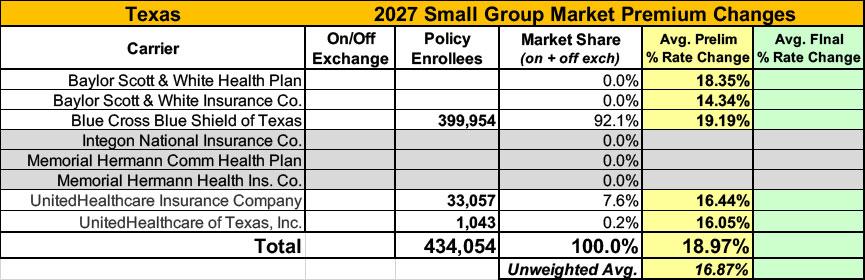
Texas' small group insurance market only has eight carriers participating in it this year...and three of those appear to be leaving next year (Integon and both divisions of Memorial Hermann). The remaining five carriers are seeking unweighted average premium hikes of 16.9% in 2027:
Advertisement


